Make $16,800 Solo Without a Team? Full Guide to Top 3 Open Source AI Short Drama Tools on GitHub, Works for Total Beginners
Hi everyone, this is Tech Global View, your go-to source for cutting-edge internet tech insights and actionable money-making opportunities for regular people. Today we’re bringing you proven, field-tested open source solutions that let you produce entire short dramas alone, without a full production team. We recommend saving this guide first before reading — you might not find it again later.
01 The Unbelievable 2026: AI Short Dramas Have Entered the "One-Person Crew" Era
Recently, I came across an AI short drama made entirely by one person that got 418,000 likes — the no-team, AI-only production model has already delivered tangible results. 2026 industry data is almost shocking: Zhan Xian Tai AI Live-Action Version hit 100 million views in 6 days after launch, there are already more than 10 AI short dramas with revenue exceeding $1.4 million, and the entire animated short drama market is heading straight for the $42 billion mark. AI tools have cut short drama production costs by 90%, and now even a single person can handle the entire process from visual design to final film output.
Wondering if there are free, open source solutions for this "one-person crew" capability? I searched most of GitHub and found 3 projects that have fully functional end-to-end workflows from script to finished film, all tested and usable by myself.
02 Tested and Working: 3 Open Source End-to-End AI Short Drama Projects
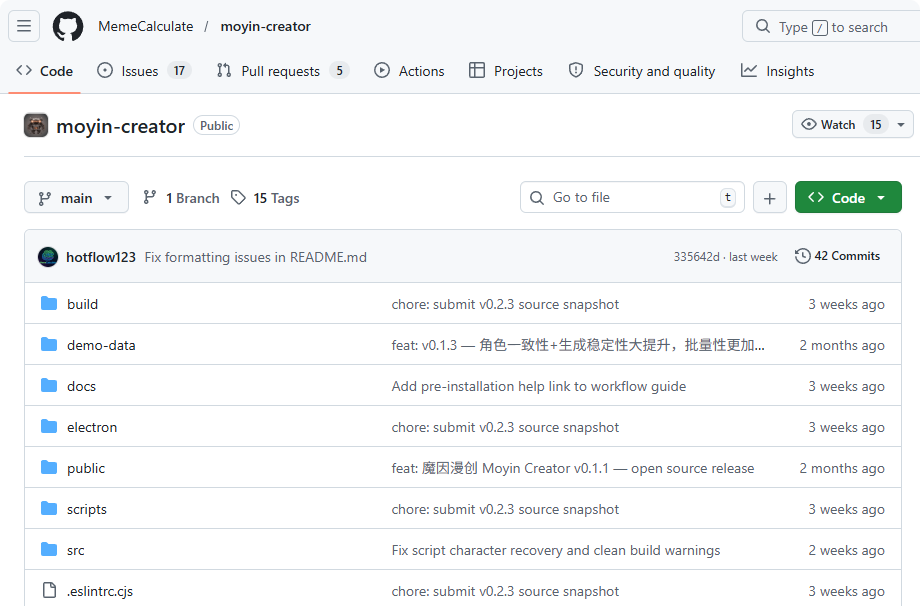
2.1 Moyin Creator: Industrial-Grade Mass Production Pipeline
GitHub Address: http://github.com/MemeCalculate/moyin-creator
This desktop application follows a formal "AI studio" framework, deeply integrated with ByteDance’s Seedance 2.0 model. It breaks short drama production into 5 standardized steps: script → character design → scene design → storyboard → final film, with batch operation support for every step.
Simply put, you don’t have to polish each shot one by one — all shots for the entire drama can be queued for generation at the same time. Once you lock in character settings, all subsequent storyboards automatically reference the same set of reference images, solving the long-standing pain point of character inconsistency across shots at the process level.
✅ Suitable for: Creators with basic AI tool experience who want to efficiently produce multi-episode consistent content. If you have used Jimeng AI or ComfyUI to make single videos and want to upgrade to "mass production of short dramas", this project is worth exploring in depth.
❌ Not suitable for: Complete beginners, it has a certain learning curve, requiring basic understanding of storyboard logic and prompt writing.
2.2 oowaoo AI Film & TV Studio: One-Click Web Novel to Short Drama Conversion
GitHub Address: http://github.com/saturndec/waoowaoo
This project targets a very specific pain point: how to quickly turn hundreds of thousands of words of web novels into publishable short dramas. Almost all hit AI short dramas are adapted from web novel IPs, but extracting characters, sorting out scenes, organizing plot lines, and converting them into shootable storyboard scripts from novels is extremely time-consuming — I’ve seen people spend a full week just breaking down a script.
What oowaoo does is fully automate this step: you input the novel text, it automatically analyzes character relationships, identifies key scenes, extracts plot nodes, and directly generates a complete short drama/comic video with dubbing, effectively saving you the labor cost of both "screenwriter + storyboard artist".
✅ Suitable for: Creators with web novel resources who want to make novel-adapted short dramas. If you find a good story on platforms like Tomato Novel or Qimao and don’t want to spend a lot of time breaking it down, this tool can give you a first cut of the film in less than 2 hours.
⚠️ Note: The quality of automatically generated scripts varies, and the handling of key turning points and emotional climaxes often requires manual fine-tuning. The tool can help you complete 80% of the basic work, but the remaining 20% is the core that determines whether your work becomes a hit.
2.3 huobao-drama: Zero-Basics Fully Automatic Film Production Tool
GitHub Address: http://github.com/chatfire-AI/huobao-drama
If the first two projects seem a bit complicated to you, this one is made for complete beginners, with a design philosophy of three words: fully automatic.
You only need to input a sentence, a theme or a rough script outline, and it automatically completes the entire process in the background: script rewriting → character extraction → storyboard breakdown → AI image generation → video generation → TTS dubbing → FFmpeg synthesis → subtitle overlay → final film export.
That’s right, from the moment you input "make a post-apocalyptic survival short drama" to getting a video file that can be published directly, you don’t need to use any third-party tools in between. This is the most automated open source AI short drama solution I have seen so far, bar none.
✅ Suitable for: Zero-basics users who want to quickly experience the full process of AI short drama production. Even if you don’t know what a storyboard is, you can use this tool to run through the whole process first, build a perception of the entire workflow, and then study more sophisticated tools later.
❌ Limitations: Full automation means you have limited control over picture details. If you have high requirements for picture quality and character consistency, you should still choose Moyin Creator or build your own ComfyUI workflow.
03 Selection Guide: How to Choose Between the 3 Tools?
Here is a simple and straightforward selection logic for you:
1. If you want to test the waters first and see what AI short dramas are all about: Choose huobao-drama, you can get a finished film in 10 minutes, just experience it first;
2. If you have novel IP resources and want to quickly produce content to test the market: Choose oowaoo, direct web novel conversion is its core strength;
3. If you already have AI video production experience and want to mass produce multi-episode short dramas: Choose Moyin Creator, its industrial process can maximize your production capacity.
You can also use the three tools in combination. For example, first run a proof of concept with huobao-drama, and after confirming that the theme has market demand, use Moyin Creator to re-produce a high-quality version.
04 Supporting Tool List: All the Best Performing Tools Right Now
Open source projects alone are not enough, you need to match them with handy tools to improve efficiency. Here are some of the best tools I have tested personally:
✅ Video Generation: Jimeng AI (Seedance 2.0): Developed by ByteDance, it is currently recognized as the strongest video generation model, supporting image-to-video, text-to-video, and multi-image reference. The new 3.5Pro version already supports synchronized audio and video generation, with free daily quotas, perfect for beginners to practice with;
✅ Character Consistency: Keling AI / Keling O1: Developed by Kuaishou, its version 2.6 has made a qualitative leap in character memory and cross-shot consistency, with annual revenue exceeding $300 million, a clear leader in the segment;
✅ Multi-Episode Production: SenseTime Seko 2.0: Supports series creation of up to 100 episodes, already used by more than 200,000 creators, and its cooperative short dramas have repeatedly topped the TikTok AI short drama list;
✅ Local Solution: ComfyUI + LTX Workflow: Open source and free, it can directly output 12-second videos from four-panel storyboards, no queuing or review required, but it has high requirements for graphics cards, suitable for people with technical background;
✅ Script/Storyboard: Doubao / Claude / Qwen: Let large language models write scripts, break down storyboards, and generate prompts for you. Don’t write these manually from scratch — let AI generate the first draft and you revise it, your efficiency will increase 10 times directly;
✅ Dubbing: Yusheng TTS / GPT-SoVITS / CosyVoice: TTS dubbing tools, some support voice cloning, some support emotion control. Yusheng TTS is the easiest to get started with, GPT-SoVITS has the best effect but is more difficult to deploy;
✅ Editing and Synthesis: CapCut (Jianying): National-level editing tool, the 2026 version has built-in AI text-to-film, digital human, and voice cloning functions, and is also integrated with Jimeng AI data, making the short drama post-production process the smoothest.
05 Tested and Feasible: A Complete Profitable Workflow
With tools and projects in place, here is a complete workflow that has already delivered monetization results:
1. Write the script: Use Doubao or Claude to write the short drama script, following the "hook → development → twist → ending" structure, 500 to 1200 words per episode. Prioritize themes that have been proven by the market: post-apocalypse, romantic comedy, suspense, immortality cultivation. It is best to find a differentiated angle, as immortality cultivation and time travel themes are already extremely saturated now;
2. Break down the storyboard: Mark segment number, picture content, dialogue, shot type, camera movement, emotion for each segment, one segment corresponds to one main action. Let AI generate the first draft, then fine-tune it yourself;
3. Finalize character design images: Use Jimeng AI or NanoBananaPro to generate character images, lock the seed value. This step cannot be sloppy, character consistency is the biggest technical hurdle for AI short dramas;
4. Write prompts: Follow the fixed formula: subject + action + scene + lighting + camera language + style + picture quality + constraints. Repeat style words and picture quality words for each segment, and be sure to add "same character, same clothing, same hairstyle" for character segments;
5. Generate video segment by segment with Seedance 2.0: Choose 9:16 vertical screen, upload character reference images to lock faces, generate 3 to 5 versions for each segment and pick the best one. This step is the most time-consuming and luck-dependent — sometimes the generated picture is so amazing you want to screenshot and post it on social media, sometimes the character directly grows six fingers;
6. Splice in CapCut: Mainly use hard cuts according to the storyboard order, add dubbing, BGM, and subtitles;
7. Publish: Publish on Hongguo Short Drama, TikTok, Kuaishou, prioritize platforms with support policies first. There are already people who made a 6-episode animated short drama alone and earned more than $16,800 in platform revenue shares.
06 Mistakes We Have Made, Don’t Repeat Them
1. Don’t neglect your script: No matter how strong the tool is, it can’t save a bad story. Almost all hit AI short dramas are adapted from web novel IPs, not because of superior technology, but because the story itself has already been verified by millions of readers in the market. If you do original content, first check what themes are popular on Tomato Novel;
2. Double-check character consistency repeatedly: If the female lead has an oval face in one shot and a square face in the next, viewers will swipe away immediately. Reference the same reference image for every segment, don’t be lazy;
3. Shot duration can get out of control: You write 3 seconds in the script, but the tool may automatically extend it to 10 or 15 seconds, doubling the final film duration, you can only manually crop it in post-production;
4. Don’t pursue perfection from the start: First run through the whole process with a fully automatic tool like huobao-drama to understand what the entire process looks like, then go back and optimize each link one by one. I have seen too many people struggle for three days on "which AI model to choose to generate character images" and end up not producing a single video.